
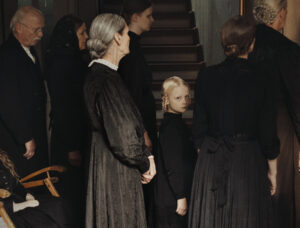
Told in four braided stories, each set in a different time period in the same residence in the Altmark region, Sound of Falling traces a lineage of girls coming of age in Germany across a godforsaken century. Each character—Alma in the early 20th century, Erika in the 1940s, Angelika in the 1980s, and Lenka in the present—endures hardships specific to her historical moment, but all their experiences echo through time, reflected in the eyes of the women who came before them and those who come after. And each perseveres through small acts of rebellion while nurturing secret desires. With a look inspired by photographer Francesca Woodman, Sound of Falling’s baroque tableaux are rich with texture and cloaked in deep shadows. Occasionally, the characters catch us watching and meet our gaze, complicating our presence and giving the film a potent hauntological essence. Each chapter is poignant and beautifully conceived, but it’s the quantum entanglement between the timelines that makes the film remarkable, tapping into the psychic residue passed down through generations that is so central to 20th-century German culture and cinema. After winning the Jury Prize at Cannes, Sound of Falling announces Mascha Schilinski’s arrival at the upper echelon of the European art house scene. ~OO
Under the motto “AMONG FRIENDS (UNTER FREUNDEN),” the Goethe-Institut USA is launching a campaign to strengthen transatlantic ties. The goal is to expand existing networks and create new hubs for sustainable exchange between German and American societies. You can find more information about the initiative on the AMONG FRIENDS website.